


Inter Smart
Talk to our expert today
Google’s capabilities have expanded beyond word comprehension. It now understands what you really want.
An article today can still reach the top position on Google without including the target keyword. The fundamental reason behind this is that Google understands the user’s intent and not merely the search terms. To illustrate, in case an individual types a question like “What is digital marketing?”, Google concludes that the user is looking for a detailed online marketing tutorial.
The statistics support this fact very well. Meeting the search intent is still the main focus of Google. Websites that satisfy search intent enjoy higher ranking, better interaction and more sales.
Search intent is the reason a user enters a search query into a search engine. It’s not about what someone types. It’s about what they really want to find.
Let’s take a simple example. Someone searches for “chocolate cake”. What does this person want? A recipe? To buy a cake? To learn the history of chocolate cake?
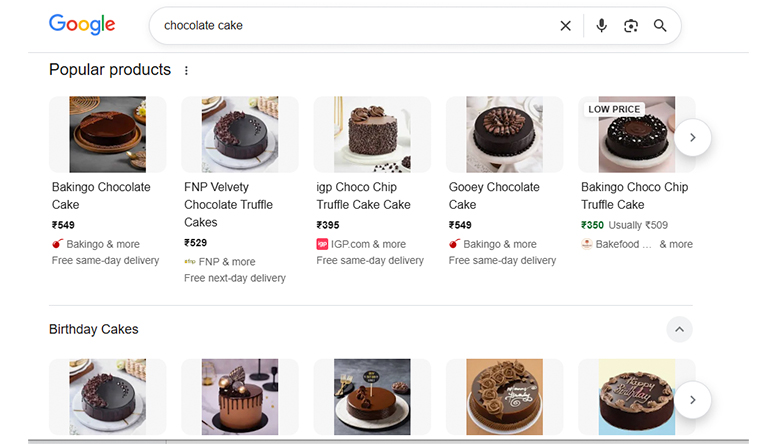
Google has to figure that out. And it’s gotten incredibly good at it.
This works through:
In the past, you could trick Google. You simply repeated “chocolate cake” 50 times in an article.
This means Google no longer just reads words. It understands meaning and context.
Not all searches have the same intention behind them. There are four main types that every website owner needs to understand.
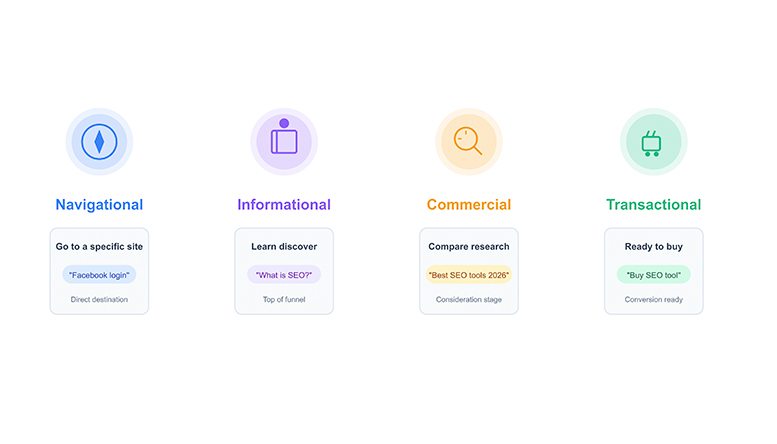
Navigational Intent is the user’s intent to visit a specific website or action on the website. For example, “Facebook login”. This individual is not interested in Facebook-related information. They want to go directly to the login area.
These are less specific, high-level, and very broad searches where the user is willing to discover more about a subject. For instance, “What is SEO?” The person is at the very starting point of their journey, collecting information.
The user is more to the supporting part of the buying process. They are weighing the pros and cons of different products, researching reviews, and comparing prices. For example, “Best SEO tools 2026”. This user is ready to make the purchase but is not fully informed yet.
These queries are performed by users who are ready to either buy or convert. For example, “Buy SEO tool.” The purchase has been decided.
This approach will result in more website visitors, better target leads and increased sales.
Keyword stuffing refers to a practice where a website excessively utilises a specific word or number with the main intention of being indexed at the top by Google. These phrases are very often included in a manner that is not natural and sometimes are even listed or mentioned totally out of context, which results in very unclear and difficult-to-understand content.
Google’s algorithms have reached an unprecedented level of efficiency in identifying manipulative practices, one of which is keyword stuffing. Rather than leading to higher rankings, it frequently results in penalties.
Websites that rely on keyword stuffing experience:
Algorithmic penalties: Google immediately recognises unnatural keyword repetition. The result: ranking drops, sometimes overnight.
Poor user experience: Unnatural repetition of keywords disrupts the flow of reading. Users will quickly get bored, and this will result in higher bounce rates and lower engagement.
Outdated SEO approach: The current scenario in SEO is such that the modern-day search engines are giving utmost importance to semantic search, user intent, and overall content quality. Keyword stuffing is no longer practised and is regarded as a relic of the past SEO era.
Search engines deduce the user’s motive by analysing how the query is phrased, the user’s behaviour, and popular searches. SERPs rely on machine learning for analysing the meanings of the words and the user actions like clicks, time on the page, and bounce rate to estimate whether a person is in a stage of requesting information or comparing options, or even ready to make the purchase.
Informational intent is usually signalled by the use of question words like who, what, when, where, why, and how.
Transactional intent is guessed by the use of action words like buy, purchase, or discount.
Commercial intent is suggested by the use of comparison words like best, review, or compare.
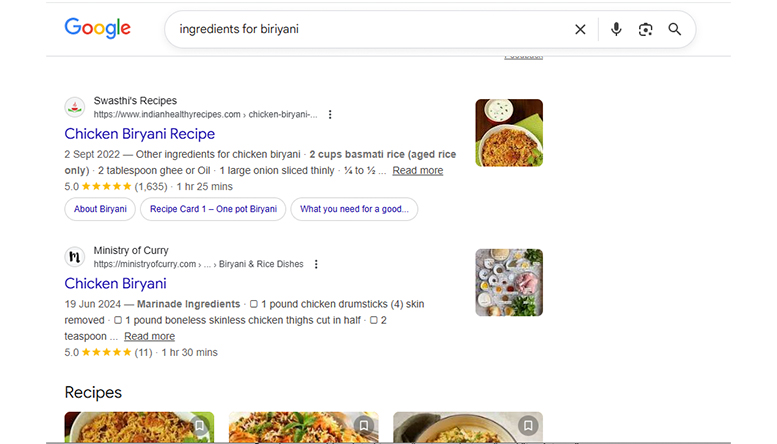
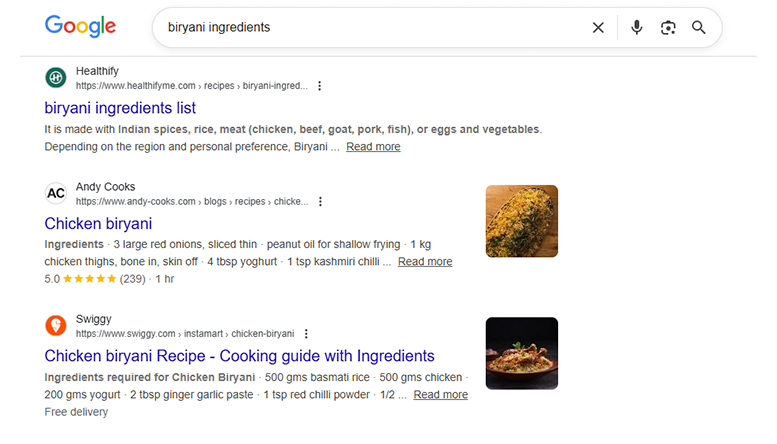
The placement of the words is also significant. For instance:
“Ingredients for biriyani” might refer to the homemade recipes.
“Biriyani ingredients” is likely to refer to the product-related searches.
Location: The search term “bike repair” suggests the nearby repair shops.
Device: Mobile users are more likely to receive quick responses.
Search history: Past searches are a good indicator of what the user probably wants.
Search results layout: The presence of videos, maps, or shopping results ranking at the top will be a sign of the intent.
Page content: Search engines analyse the format, depth, and media of the top-ranking pages.
Search engines use anonymised user activities, like clicks and time spent on pages, to comprehend what content is satisfying for the users. The relevance for future searches gets enhanced by these signals.
Search intent optimisation doesn’t mean ignoring keywords. It means using them intelligently.
The most effective way to understand search intent is to look at what is currently ranking. These pages are the ones that Google has deemed the most useful and accurate for users who enter your target keyword.
Let’s take the keyword “tyres”. The SERPs show articles about tyres for different vehicles. Google even adds related terms: “motorcycle tyres” and “truck tyres”.
This tells you that users want a comprehensive overview, not just information about one type of tyre.
A major indicator that your page doesn’t match the intent is the bounce rate. If your content doesn’t match the search intent, people won’t want to read it.
High bounce rates can also indicate other problems. But they definitely help identify underperforming pages.
Inter Smart analyses the bounce rates of all pages. If a page is performing poorly, we first check: Does it fulfil the search intent?
When you think about search intent for your business, you need to map out your sales funnel. This practice not only helps you create content for all users but also tailors each page to their needs.
Latent Semantic Indexing is what LSI means. It might sound complex, but in reality, it is very straightforward. LSI keywords are basically the main keyword’s synonyms that are already designated by the search engine.
Google is not interested in the number of times a keyword has been used in the text anymore. It is much more concerned with LSI keywords. The presence of LSI keywords clarifies the content of the page to Google.
Suppose you are going to write a piece on “Apple”. Would it be the fruit or the tech company that you mean?
LSI keywords provide clarity:
Fruit: vitamins, nutrition, recipes, orchard
Company: iPhone, MacBook, iOS, Steve Jobs
When Google sees a page with LSI keywords, it helps to avoid keyword stuffing.
Where can you find LSI keywords? Scroll down on Google to “Related searches”. The terms in bold are LSI keywords.
Inter Smart utilises professional tools, such as Semrush and LSIGraph, to create comprehensive lists of LSI keywords. These are naturally incorporated into the content, never forced.
The best content strategy for 2026 is based on these principles:
Understand what your audience needs and deliver the answer early in your content. Keep readers engaged by providing value quickly.
This means: No long introductions. No irrelevant stories. Get straight to the point.
Integrate keywords naturally and sparingly. Use synonyms and related terms to maintain relevance without overloading the page.
Forcing a keyword into a post or header harms the user experience. Instead of saying “keyword stuffing” in this post, I could say “overuse of phrases for SEO”. It means the same thing.
Readers will quickly get bored if I constantly say “keyword stuffing”. By varying the language, I can maintain their interest, and search engines can still determine that it’s the same.
Generative engines need well-structured content that is concise, direct, verifiable, and human-readable.
This means:
Answer Block (40-80 words): An AI might quote the following concise, self-contained explanation.
In-depth follow-up sections: The answer is significant; it has applications, and illustrative processes with examples and case studies can be presented.
Semantic connections: Semantic connections enhance the probability of your webpage being seen in long-tail queries, follow-up questions, AI-generated answer expansions, featured snippets, and multi-intent SERPs.
Search engines can’t “see” your layout, but they do pick up on the signals your layout generates. They favour pages that reduce bounce rates, offer smooth reading, and support next-step decisions.
This means: Clear headings, sufficient spacing between paragraphs, internal linking, and optimal content density.
Inter Smart has focused on search intent optimisation from the very beginning. Our website development is not based on outdated keyword tactics.
Data-driven approach: We analyse the SERPs for every target keyword. What is currently ranking? Which intent types are being served? Which questions are being answered?
Comprehensive keyword research: We use tools like Semrush, Ahrefs, and Google Search Console to not only find keywords but also understand the intent behind them.
Content structuring: Every article is structured to optimally fulfil the search intent. Answer blocks for quick answers. In-depth sections for detailed information. Semantic connections for comprehensive coverage.
Continuous optimisation: Search intent changes. Google SERPs can change regularly for the same query. Google always aims to deliver better results that more accurately fulfil the actual search intent.
Inter Smart continuously monitors your rankings. If the intent changes, we adapt the content.
Even with a good strategy, there are common mistakes that can undermine your efforts.
Mixing multiple intent types on one page
If you try to optimise a webpage with multiple keywords with different intents, you’ll create a big mess on your page. It will confuse search engines in understanding your content and who it’s for, preventing your page from ranking for the right keyword.
Solution: One primary keyword per page. A clearly defined intent. Anything else confuses Google and your users.
Most SEO experts recommend keeping keyword density between 1-3 per cent.
But here’s the truth: Keyword density is almost irrelevant in 2026. Natural language flow, comprehensive topic coverage, and fulfilling the search intent are what matter.
If you try to force synonyms or awkward phrases into your writing just to vary your keywords, the algorithms can detect that.
Write naturally. Use synonyms when they fit. Don’t force anything.
Just because keywords are related doesn’t mean they belong in the same cluster. Always validate clusters against the actual search intent.
Check the SERPs. If Google shows completely different results for two keywords, they have different intents. Treat them separately.
Search intent optimisation works. But you need to measure the right metrics.
Don’t just track generic keywords. Track queries that reflect your target intent.
If you create informational content, track “how”, “what is”, and “why” queries. For transactional content, track “buy”, “price”, and “best” queries.
Average time on page increased from 12 seconds to 1.3 minutes, an indicator that readers appreciated the improved content.
Time on page, pages per session, scroll depth. These metrics show whether your content fulfils the intent.
Ultimately, what matters is: Are visitors converting? A website that perfectly fulfils the intent naturally leads users to conversion.
Inter Smart tracks conversion rates at every intent level. TOFU content should generate email sign-ups. MOFU content should generate demo requests. BOFU content should close sales.
The era of keyword stuffing is over. In 2026, it’s all about search intent optimisation.
Google’s goal is to answer search intent and give users the results they want. Websites that understand and implement this will be rewarded. Websites that rely on outdated keyword tactics will be penalised.
The data is clear. In 2026, when the competition is fierce, content that targets only a single keyword but misses the underlying user intent will struggle.
Inter Smart recognised this trend early on. User-centred content leaves a lasting impression and creates a relationship of trust between the brand and the customers, which, in turn, through signals like E-E-A-T, helps to create the visibility of the brand in search engines.
If you want to be successful in 2026, stop counting keywords. Instead, start fully comprehending user intent and gradually creating high-quality content that not only solves problems but also answers questions and provides value.
This is the bright side of SEO. And Inter Smart is leading the way.
Need guidance? Request a callback, and our expert will reach out at your convenience.