


Inter Smart
Talk to our expert today
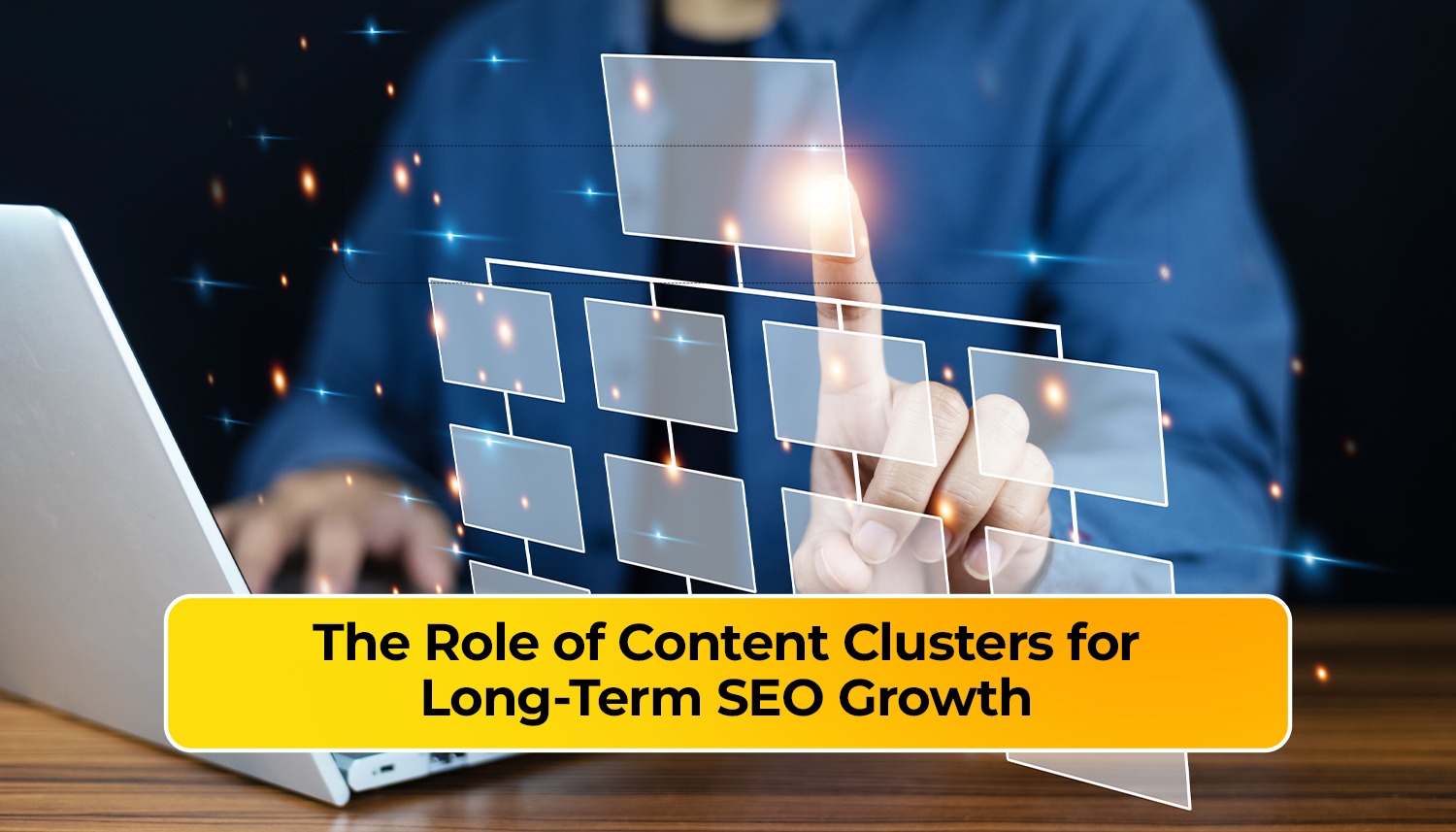
Content organised in clusters generates 30% more organic traffic. Content clusters maintain rankings 2.5 times longer than standalone articles.
The June 2025 Core Update from Google confirmed that websites need to demonstrate their expertise on specific subjects. The system gives higher value to websites that demonstrate complete and trustworthy coverage of a particular subject matter.
Scattered blog posts and isolated landing pages no longer work. Without clear topic organisation, ranking is more difficult, and navigation is more frustrating, especially for users who rely on accessibility tools.
It’s high time we look at the role of content clusters for long-term SEO growth.
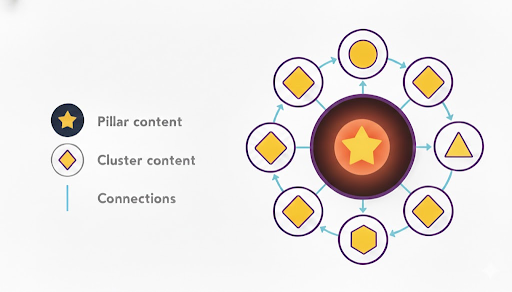
| Content clusters are groups of related content organised around a central pillar page. This structure has existed for years, but its formalisation and popularisation have increased in recent years. |
Pillar Page: Pillar pages serve as primary content hubs. The links connect to high-quality content, which helps develop subtopic keyword connections. The content needs to follow on-page SEO best practices through required elements, which include page title, URL and H1 tag components.
Cluster Pages: Each topic cluster page delves deeper into a specific angle or question related to the main topic. The links return to the main pillar page. The pillar page provides links to all cluster pages.
Internal Links: The connective tissue. Search engines use contextual internal links, which include descriptive anchor text, to determine how words connect with each other and to evaluate the level of knowledge of a webpage.
The better performance of content clusters compared to standalone articles occurs because content clusters provide more value. The current SEO landscape requires websites to provide contextual information about their content instead of just using keywords and metadata. Google now prioritises content context while assessing website relevance and structural elements more than in previous times.
The June 2025 Core Update from Google prefers content which meets all user requirements through comprehensive and understandable content which delivers practical value. The update penalised websites which only included keywords without providing actual value to users.
When businesses develop relevant content which establishes their expertise, Google recognises them as experts in that field. This is E-E-A-T (Experience, Expertise, Authoritativeness, Trustworthiness) in action.
The previous SEO method required multiple web pages which targeted different forms of the same keyword. The web pages, because they competed for the same search engine traffic, created confusion for search engines.
The search terms “best running shoes,” “top running shoes,” and “running shoes reviews” function as near-duplicate keywords. The result was a diluted authority spread across too many similar pages.
The current content architecture system uses hubs and spokes together with internal linking methods to create effective content delivery systems. SEO specialists today need to answer two questions: which keywords should they target, and which topics should receive complete coverage through all interconnected content.
The pillar-cluster model depends on internal linking as its main operational element. Any content cluster strategy requires a specific internal linking method to build its entire system.
Internal linking provides multiple SEO benefits because it helps: Distribute link equity. Improve crawlability. Encourage visitors to explore related content.
Users find it easier to navigate through the website, while internal links assist them in discovering essential content.
Most pillar pages fail at the design level. Their content strategy shows success, yet the visual structure causes readers to leave.
Pillar content needs a strategic structure. A blueprint for your content ecosystem. The well-organised pillar pages enable search engines to comprehend your content better, which results in improved user experience and extended visitor retention time.
Many successful pillar pages follow the buyer’s journey framework: Awareness, Consideration, and Decision stages. The logical sequence assists readers in understanding difficult subjects while meeting their informational requirements during each phase.
Start with broad, definitional content that answers key questions about the topic. Then move to more specific, detailed content.
Your pillar page should have at least 2,000 words. The text needs length for its content, but does not require any particular length. The critical element for success needs to be organised.
The content should use clear headings, which include H2 and H,3 to create sections which readers can easily understand. The content should include lists and bullet points, which should be used in suitable situations. The content should include visual elements which consist of images, infographics and videos.
The content should include eight to twelve specific articles which will support each pillar. The pillar needs to contain links which connect to all the supporting materials. The main keyword requires backlinking, which uses consistent descriptive anchor text to support your content needs.
The site needs pillars to create breadcrumbs, which establish parent-child relationships. This creates direct navigation routes which users and search engines can use.
Update your XML sitemap to assign higher priority to pillar pages. The algorithms can detect your emphasis on cornerstone content through your use of algorithms.
Cluster pages support the pillar page, but they must also offer standalone value.
Each page can function independently.
Structure your outlines so that both the pillar page and the cluster pages provide value independently. Each page should thoroughly address its topic. Readers should be able to understand it without reading other pages.
At the same time, they should, of course, link to the pillar page and vice versa.
For each cluster piece, conduct comprehensive research on related topics and keywords. You must organise your cluster material to match the main themes of your pillar page. The tools Ahrefs, SEMrush, and Moz Keyword Explorer enable you to find suitable subtopics for your research.
Your links should become an essential element of your sentences because they provide value to the reader. The phrase “Click here for our SEO guide” should be replaced with “Our comprehensive SEO audit checklist can help you identify technical issues.”
The cluster pages need to establish links back to the pillar page using appropriate anchor text, which includes “comprehensive content marketing approach” and “overall strategy framework.”
The correct quantity is determined by how extensive and comprehensive the subject matter is.
Success requires 10-15 blog posts supporting each pillar page. Plus another 10-15 blog posts for cluster pages. Although this requirement appears excessive, the content ecosystem delivers ongoing organic traffic benefits after its establishment.
Not all topics need the same number of clusters. The broad topic of Digital Marketing requires 15 or more clusters to complete its coverage. The narrow topic of Email Subject Line Testing requires 5 to 7 clusters to achieve complete coverage.
The research should concentrate on producing in-depth outcomes instead of measuring growth through numerical expansion. The user experience needs to exist in each cluster because it must include actual benefits for users.
The measurement system needs to assess your optimisation processes because you cannot optimise without measurement. The right metrics are critical.
Research shows that pillar pages often rank at the top of search results. This creates massive traffic potential. Track organic traffic to pillar and cluster pages separately.
Compare performance before and after cluster implementation. A 30% traffic boost is average. Top performers see 50-100%+ increases.
Cluster content maintains rankings 2.5x longer than standalone pieces. Track ranking volatility over time. Stable rankings mean Google trusts your authority.
Use tools like Screaming Frog or Semrush Site Audit to analyse internal link distribution. Pillar pages should receive significantly more internal links than average pages.
Engagement metrics show whether content resonates. Pillar pages with good structure should have higher time on page and lower bounce rates than the site average.
Content clusters never reach a “finished” state. They require constant growth.
Your regular data analysis should: Track the performance of each cluster piece. Identify content gaps. Update outdated information. Find new opportunities for cluster expansion.
Pillar content functions as an active resource for libraries. This approach helps organisations keep their online presence active while maintaining their expertise and search engine ranking.
Your current pillar needs new clusters because new topics have developed and search trends have shifted. Google recommends that websites limit their internal links to 100 links per page, which helps maintain their search engine optimisation. The rule restricts you to a specific number of clusters which you can associate with a single pillar. If you have too many clusters, consider creating a second pillar.
Regularly refresh old cluster pages. Update statistics. Add new examples. Improve visuals. Google rewards fresh, updated content.
Content that uses cluster organisation leads to 30% more organic traffic while maintaining its current position for 2.5 times the average duration.
The structure establishes three elements: Pillar pages function as the main hubs, while cluster pages provide supporting elements, and strategic internal linking creates the network connections.
The advantages are measurable through five factors, which include Higher organic traffic, more stable rankings, better user experience, stronger topical authority, and reduced keyword cannibalisation.
Inter Smart follows these principles with complete understanding. We develop permanent content ecosystems for our customers which need systematic approaches. The performance of our content marketing strategies delivers measurable results for our clients.
The difference between successful sites and unsuccessful sites involves their organisation rather than their budget. Content clusters transform scattered content into a cohesive topic ecosystem that search engines reward with rankings while users experience better engagement.
Contact Inter Smart today. Our content cluster strategies from development through implementation create ranking systems that deliver continuous results.
Need guidance? Request a callback, and our expert will reach out at your convenience.